
Mervin tests the free Plannotator plugin: Claude Code's plan opens in the browser, he marks three notes on it, and the revised plan follows all three before any code changes.
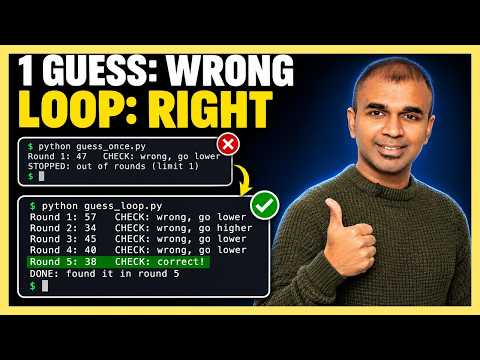
Mervin Praison shows 'loop engineering': an AI guesses a secret number, your code checks each guess and sends back higher/lower hints, and a round limit stops the run. Try, check, feedback, stop, in 25 lines with PraisonAI and an OpenAI key.
Mervin Praison · YouTube · published Nov 7, 2026 · Software & DevOps
 ▶ Watch on YouTube
What does this AI loop check on every round, and when does it stop? Explain the try, check, feedback and stop parts, and make sure there is a maximum number of rounds.
Loop engineering means putting an AI in a loop that tries, gets checked by your code, receives feedback and stops. In 25 lines of Python an AI finds a secret number in 5 rounds from higher/lower hints, and one round-limit line prevents an endless bill.
The problem: A single AI guess is often wrong, and typing every follow-up message yourself doesn't scale.
The 25-line program is in the video description; the steps below follow the video.
Afterwards, ask any AI app: what does it loop check and when does it stop?
Distilled from the video’s captions
Mervin tests the free Plannotator plugin: Claude Code's plan opens in the browser, he marks three notes on it, and the revised plan follows all three before any code changes.
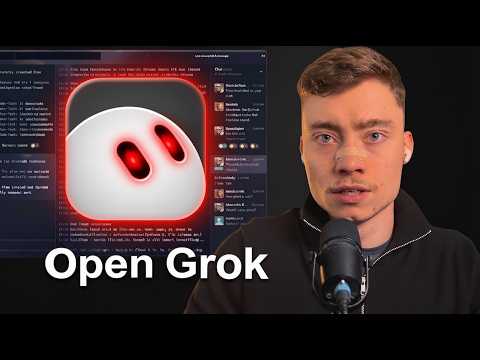
David runs several Claude Code agents in Cloud Room to reverse-engineer Grok Bot, build its UI and back end, and self-host the result on a VPS in about 1.5 hours.

Matt Wolfe has AI label every photo on his iPhone as screenshot, blurry, too far away or worth keeping, then files them into albums and builds one best-shots album from 58 trips.

Leon sets up Grok Bot, adds an architect and a 3D developer bot in one group, and gets a three-bedroom house with a pool designed, built in 3D, pushed to GitHub and deployed on Vercel.